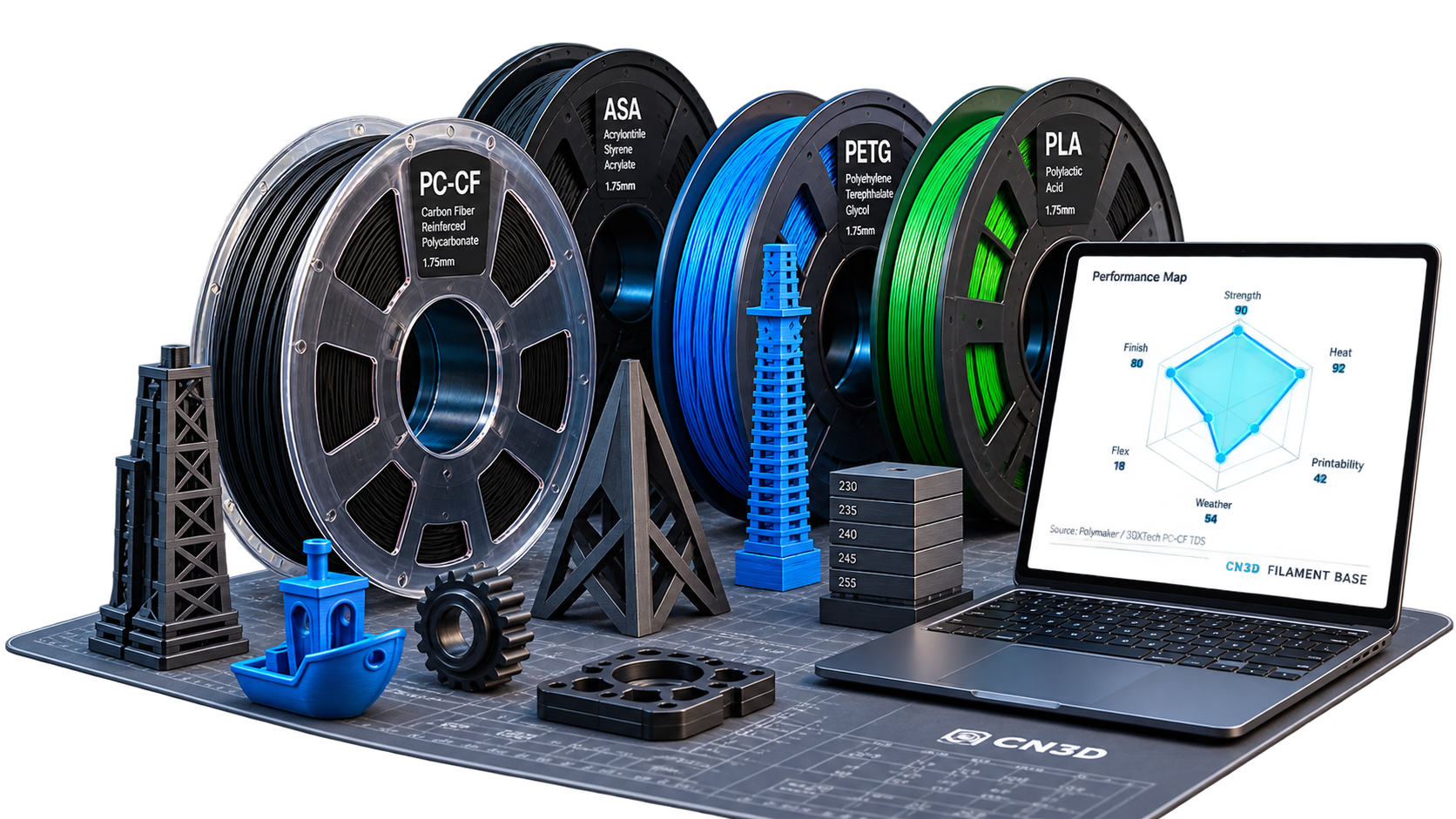
CN3D · Filament Base
A practical reference for 3D-printing materials — properties, printability, performance maps, community requests, and reviewed purchase links.
Built on Jonathan / The Next Layer’s open-source Filibrary — adapted for CN3D Docs.
Community contributors
Thank you to everyone helping improve this knowledge base.
61 materials
Easy to print, highly rigid, and affordable, PLA is perfect for decorative items and functional indoor parts that will not face high heat or sustained strain. Its low softening temperature means it can deform under warm ambient conditions or mechanical load.
Toughened versions of standard PLA — typically branded PLA+ (Sunlu) or PLA Pro / PolyMax (Polymaker). Roughly the same printability and heat limits as plain PLA, but noticeably better impact resistance and layer adhesion. A drop-in upgrade for functional parts that would normally crack in regular PLA.
The standard flexible filament, TPU is prized for excellent layer adhesion and impact absorption. It is the go-to choice for seals, bumpers, feet, and soft-touch parts when your extruder can handle flexible materials.
Despite being Jonathan's mortal enemy, PETG DOES blend strength, flexibility, and decent UV resistance, but it is hygroscopic, stringy, and sometimes annoyingly sticky on beds and nozzles. It remains a very practical functional filament when handled and dried well.
An impact-resistant, high-heat commodity plastic that is excellent for sustained loads and can be vapor-smoothed. It generally wants an enclosure to control warping and fumes.
ASA offers ABS-like strength and heat resistance with much better UV stability, making it a strong outdoor option. It still benefits from enclosure-friendly printing habits.
PEBA is a durable elastomer with better energy return than standard TPU, so it feels springier and more lively. It suits wearables, flexing mechanisms, and shoe-adjacent parts.
PC-CF combines polycarbonate’s heat resistance and strength with carbon fiber’s rigidity and dimensional stability. It is still demanding, but noticeably more manageable than pure PC.
This very soft TPE is stretchy and skin-safe, making it ideal for soft-touch grips and wearables. Its softness also makes it challenging to feed and print cleanly.
PVB is an aesthetic filament that can be smoothed with isopropyl alcohol for a glassier look. It is interesting for transparent decorative pieces, but moisture sensitivity matters.
PP is excellent against chemicals and repeated flexing, but it is notoriously hard to get sticking well. It is a true functional material when you can solve adhesion and warp control.
CPE acts like a more engineering-leaning PETG alternative with better heat and impact performance. It also tends to absorb less moisture than PETG.
NonOilen is a bio-based material with food-contact positioning and unusually strong heat resistance for its class. It is compelling for containers, molds, and eco-leaning use cases.
PA6 offers toughness, chemical resistance, and high ductility for parts that take repeated abuse. It is generally stiffer and more moisture-sensitive than PA12.
PA12 is a durable engineering nylon with lower moisture uptake and greater flexibility than PA6. That makes it a more forgiving nylon family for storage and dimensional stability.
PC is one of the toughest common thermoplastics and offers high impact resistance and thermal stability. It is also moisture-sensitive and prone to warping, so machine capability matters a lot.
PLA-CF adds stiffness and a premium matte finish to PLA. It still inherits PLA’s weak heat tolerance, so it is best treated as a rigid aesthetic or prototyping material.
PETG-CF adds stiffness and extra heat resistance to PETG while improving surface finish. It is a strong, practical composite with nicer dimensional behavior than many advanced materials.
PET-CF pushes the PETG-CF idea a little more toward premium engineering performance. It offers a matte finish, strong stiffness, and good dimensional stability.
PA-CF trades some impact resistance for huge gains in rigidity, axial strength, and heat resistance. It is one of the strongest practical consumer engineering filaments.
PAHT-CF leans even harder into hot-endurance engineering parts with strong rigidity and thermal performance. It is built for serious functional use.
ABS-CF blends affordability, durability, and moderate heat resistance while reducing the warping associated with plain ABS. It still benefits from enclosure-friendly printing.
ABS-GF increases tensile performance and keeps electrical non-conductivity, which makes it useful for housings and tool-oriented parts. It is a strong alternative to ABS-CF.
HIPS is often discussed as a support pairing, but it is also a very good standalone engineering-ish filament with impact resistance, dielectric strength, and a nice matte finish.
PCTG is essentially a tougher, clearer, more chemically and thermally capable PETG-style material. It keeps much of PETG’s practicality while improving durability.
PEBA Air uses a foaming agent to reduce density and alter feel, giving a more premium foam-like response. It is interesting for footwear, cushioning, and soft technical parts.
TPU Air softens and lightens the printed result while staying in the TPU family. It works well for grips, padding, and lightweight soft-touch parts.
ROAMR is a foamed flexible material aimed at premium performance applications where rebound and low density matter. It targets wearable and shoe-adjacent parts more directly than standard TPU.
Morphlex is designed around easier shoe printing by feeding stiffer but printing softer. It can work very well, but geometry and perimeter strategy matter.
Fishy PA6 is recycled from fishing nets and keeps the practical toughness and heat resistance of nylon 6. It brings a compelling recycled-material story to engineering prints.
OrCA adds carbon fiber to the ocean-recycled nylon concept for more rigidity and creep resistance. It is the more structural sibling to Fishy PA6.
PETG-PTFE lowers surface friction for sliding parts and moving interfaces. It is especially interesting for hubs, guides, and low-friction mechanisms.
Antibacterial CPE uses antimicrobial additives to suit hygiene-oriented environments like kitchens, labs, and shared public-touch objects.
PETG-Magnetite is a heavy, magnet-responsive specialty filament useful for switches, weighted parts, and unusual electromechanical experiments.
ASA-CF boosts rigidity and dimensional stability while preserving ASA’s outdoor advantages. It is a strong candidate for premium outdoor functional parts.
ASA-GF delivers strong outdoor and heat performance while staying electrically non-conductive. It is a practical composite for outdoor engineering parts.
PLA-HT prints like friendly PLA but can handle significantly more heat, especially after annealing. It is one of the easiest ways to step up from ordinary PLA heat limits.
PLA-HT-GF adds more rigidity and engineering flavor to PLA-HT. It is an approachable route to higher-heat parts without fully jumping into enclosure-heavy materials.
PPS-TF sits deep in engineering-polymer territory with high heat, chemical resistance, and wear performance. It usually requires serious machine capability.
PPA-CF combines strength, heat resistance, and rigidity in a very aggressive engineering package. It is one of the closest consumer options to almost metal-like stiffness.
PPS-CF pushes into industrial territory with exceptional chemical, flame, and thermal resistance. It is difficult but extremely capable.
PPS-GF targets demanding industrial environments with excellent heat and chemical resistance while favoring glass-fiber electrical behavior.
This ABS formulation aims for high speed and about 101°C temperature endurance, making it attractive for hot environments and heated-printer interiors.
GRIP TPU is explicitly designed to be grippier than standard TPU while still printing nicely. It is well suited for handles, feet, and traction-focused parts.
PHA is a bio-based, biodegradable material that prints somewhat like PLA but brings odor and bed-adhesion quirks. It is especially interesting for eco-focused projects.
LW-PLA uses foaming to dramatically reduce weight and create a balsa-like texture. It is a classic fit for RC aircraft and gram-sensitive builds.
LW-ASA applies the same weight-saving trick to an outdoor-capable engineering plastic. It is compelling for lightweight, UV-stable parts.
PC Space Grade is a specialty polycarbonate aimed at sensitive electronics and harsh environments, with low-outgassing and ESD-friendly positioning.
ABS V0 targets electronics-friendly applications by adding strong flame-retardant behavior while preserving familiar ABS-style print behavior.
PolyCast is engineered to burn out cleanly for casting workflows. It makes metal casting geometries more accessible to makers.
HDPE is famous for chemical resistance and resilience, and newer formulations make it somewhat more printable than old-school HDPE expectations.
PETG-Tungsten is a dense specialty filament for shielding-style applications where mass and attenuation matter.
CoPA blends nylon families for strong tensile performance and high heat while remaining surprisingly printable. It is an appealing engineering nylon for less dramatic setups.
TPU-GF mixes impact absorption with glass-fiber rigidity and a changed surface texture. It is a very unusual flexible composite that rewards thoughtful design.
PLA Support makes support removal easier for PLA-centric prints without needing a soluble material. It is best where access is straightforward.
PVA is a dissolvable support material ideal for internal cavities and complex geometry. Moisture management is a big part of using it well.
PolySupport PA is designed specifically to work with nylon families that are annoying to support. It solves a very practical engineering-print problem.
ABS Kevlar adds impact-oriented reinforcement with less nozzle wear and a different feel than carbon-fiber blends. It is a nice alternative in some rugged applications.
PETG Ultra-Glow is a genuinely functional glow material for visibility and safety rather than just novelty. It works for signage and emergency-style markers.
The ultimate, high-performance thermoplastic polymer known for its excellent mechanical properties, thermal stability, and chemical resistance. It is commonly used in demanding applications such as aerospace, automotive, and medical devices due to its ability to withstand harsh environments, but it can also be used in biomedical.
PBT+ is a rather obscure filament that provides many of the same properties as nylon but absorbs less moisture (humidity), which allows PBT+ to maintain its shape in wet environments. PBT+ is often used as a substitute for Nylon 6.6 or 6.12 and has better wear resistance than polypropylene or polystyrene. PBT has good mechanical properties in relation to stretching, twisting, and bending (good bend recovery). PBT is resistant to solvents. PBT+ has high UV resistance.